Nowruz
A new Iranian calendar year begins on the day of the Spring Equinox in March, which usually falls between March 19th and 21st.
Nowruz's exact timing is determined by the solar system and astronomical observations. A precise calculation is performed annually when the Sun crosses the celestial equator, equalizing night and day. This year, Nowruz falls onTuesday, March 19th 2024 at 8:06 PM.
During Nowruz, families come together, dressing in their finest attire, to gather around the Haft-Seen Table for prayers. Elders in the family present new bills or cash as gifts to the younger members.
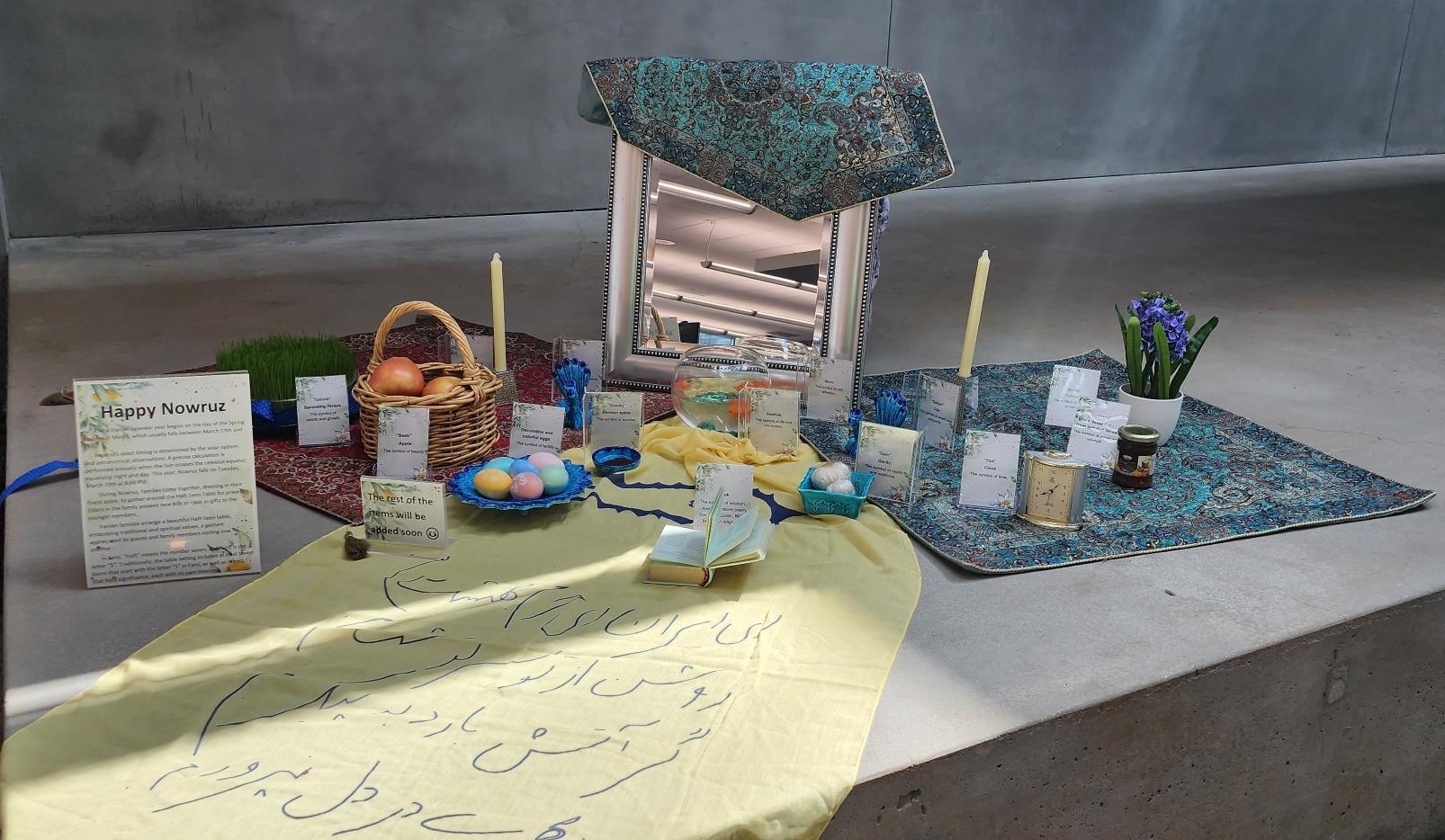
Iranian families arrange a beautiful Haft-Seen table, embodying traditional and spiritual values, a gesture appreciated by guests and family members visiting one another.
In Farsi, “Haft” means the number seven, and “sin” is the letter “S”. Traditionally, the table setting includes at least seven items that start with the letter “S” in Farsi, as well as others that hold significance, each with its own meaning.
The following are the items and the meaning behind them.
- Sabzeh: Wheat, barley, or lentil sprouts: symbolizing rebirth and growth.
- Samanu: Sweet pudding made from wheat germ: symbolizing sweetness and fertility.
- Senjed:Dried oleaster fruit: symbolizing love.
- Seer: Garlic: symbolizing medicine and health.
- Seeb:Apple: symbolizing beauty and health.
- Somagh: Sumac: symbolizing the sunrise and new beginnings.
- Serkeh: Vinegar: symbolizing age and patience.
- Sekkeh (coins): Symbolizing wealth and prosperity.
- Sonbol (hyacinth flower): Symbolizing spring and the renewal of nature.
- Decorated eggs: Symbolizing fertility and new beginnings.
- Goldfish: Symbolizing life and the flow of time.
- A mirror: Symbolizing reflection and self-reflection.
- Candle(s): Symbolizing light and happiness.
- Holy/Literature/Poem book(s): Symbolizing spirituality and faith.
- In addition to Iran, 14 other countries celebrate Nowruz:
- Afghanistan, Tajikistan, Kurdistan, Georgia, Uzbekistan, Pakistan, Albania, Turkmenistan, Kyrgyzstan, Azerbaijan, Kazakhstan, and Israel"
Thank you to Haydeh Kaveh for providing a thoughtful overview of Nowruz and for creating the Haft-Seen table in SCC's Lorenzo Ramirez Library.